
Montmorency County Criminal Docket Searches
Montmorency Courts Case Search is the local front door for a Montmorency County criminal court docket. A lookup can go two ways. It sends one route to the 88-2 District Court tenant. Once a felony binds over, it goes instead to the 26th Circuit/Family/Juvenile/FOC tenant in MiCOURT. What the public sees is a register of actions, not the filed documents themselves. Expect hearing dates, party and counsel names, case status, and financial history. The court fills in those fields.
Search with the court and case number when you have them. A name match alone is risky. Check it against the filing year, case type, charge block, and court before trusting it. MiCOURT itself calls its public results informational rather than official. Something may look incomplete. The District clerk covers the district stage. The Montmorency County Clerk covers the circuit stage.
The 88-2 District Court MiCOURT tenant is the official public interface for the opening Montmorency County criminal court. The search screen is the county's register layer. Use it to identify the case. Then contact the right clerk for anything the view does not show.
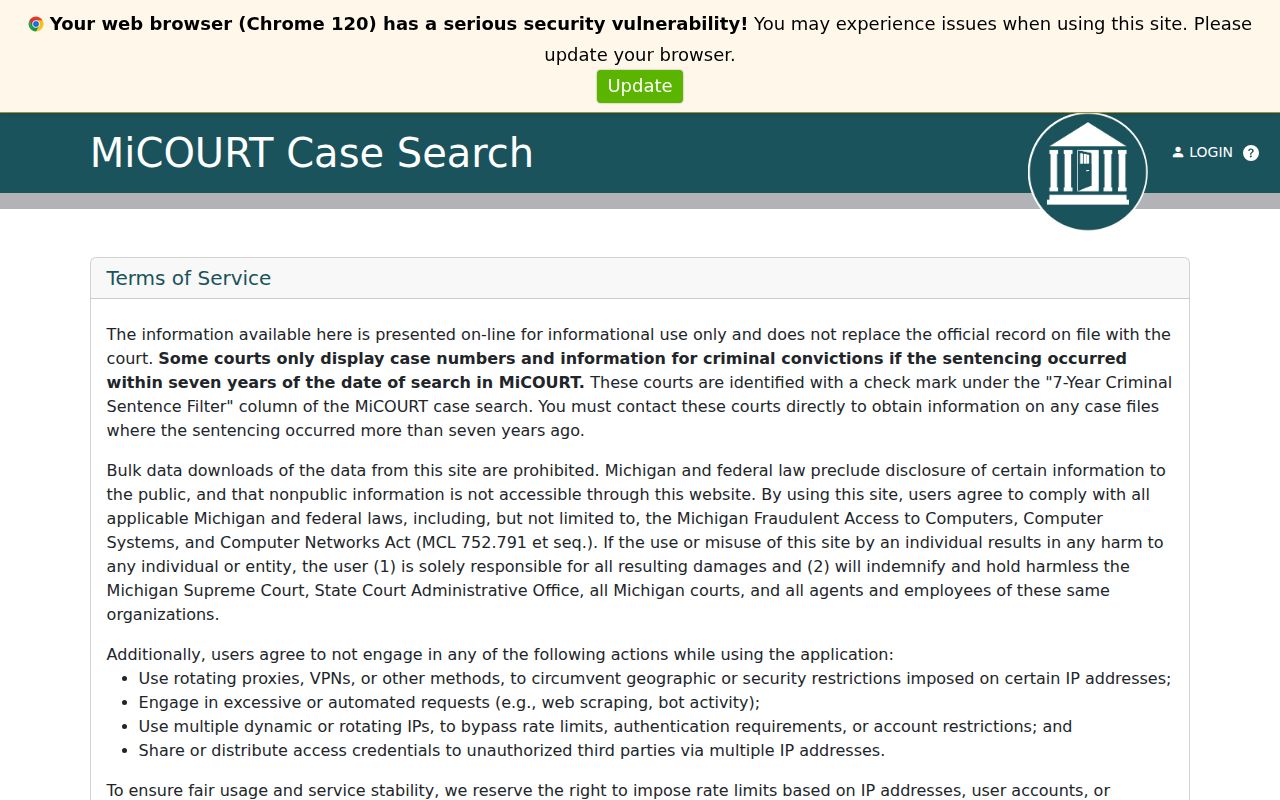
Which Montmorency County court you pick matters. A felony can appear as two records: one at district, one at circuit after bindover. Same matter, separate entries.
Montmorency County court navigation also lists Self-Help Public Computer Access. The court does not publish the terminal's location or hours. Ask before making a trip.
- Open the Montmorency County Case Search page and choose the court tenant that matches the case stage.
- Accept the public-use terms, then use the name panel or the year, number, and type fields for a Montmorency County case-number search.
- Compare the Montmorency County result's court, filing date, case type, and participant information before opening the case detail.
- Read the Montmorency County register from its earliest entry through the most recent setting, disposition, and financial event.
- Contact the proper Montmorency County clerk for a filed charging document, order, judgment, or certified copy.
Note: A Montmorency County public result can name a case event, but it does not give the full text of an unlinked filing.
Montmorency County Criminal Docket Start
Criminal cases in Montmorency County start in the 88th District Court. Defendants are age 17 and older. Misdemeanors stay there when the offense carries no more than one year, covering arraignment, trial, and sentencing. Felonies also open there, with arraignment, bail, probable-cause conferences, preliminary examinations, and felony pleas. Traffic misdemeanors and civil infractions run through the District Court's traffic and criminal side. They do not enter the circuit criminal docket.
A local District Court criminal division page lays out that preliminary role, the bail work, and the misdemeanor functions behind these Montmorency County entries. The practical rule is simple. Begin in the 88-2 tenant unless the register shows the felony already moved on.
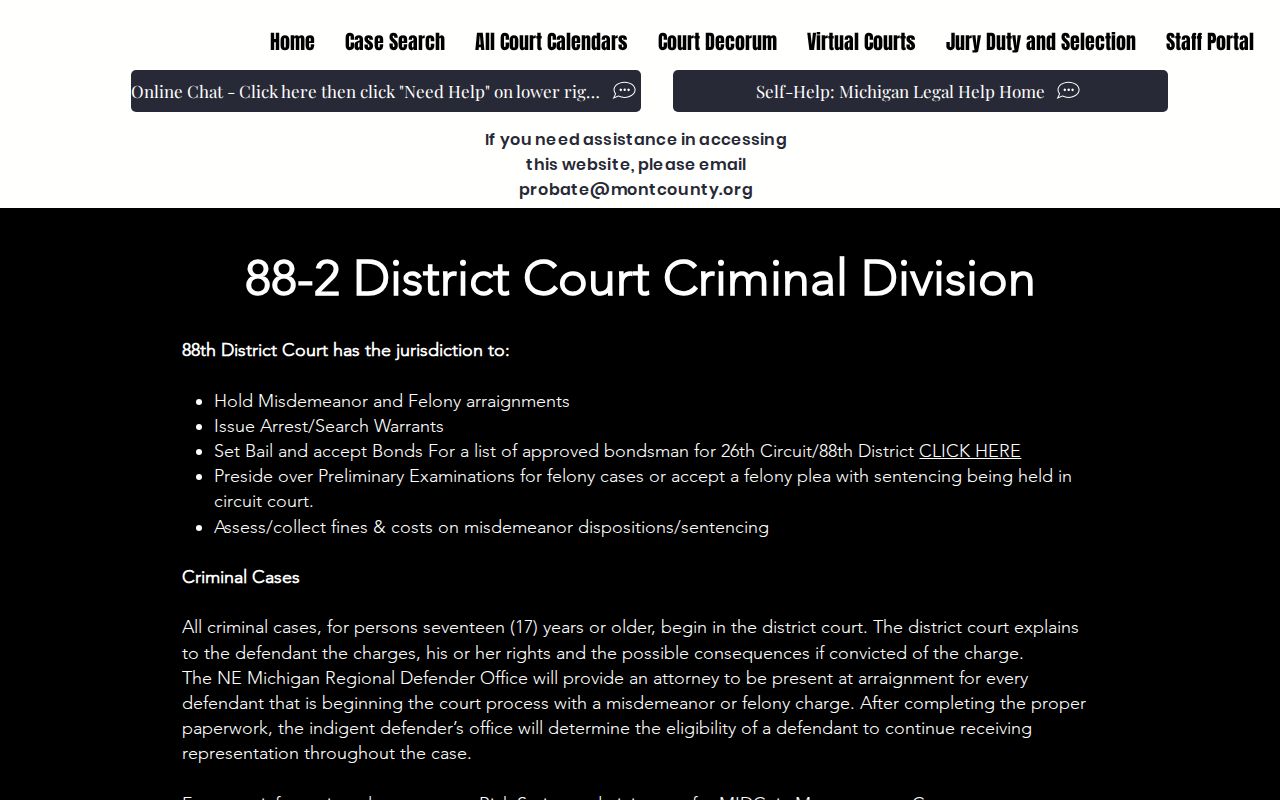
The division description points you down the right docket path. For the current status and hearing, the Montmorency County register and the clerk remain the final word.
Criminal Dockets: What They Show
A Montmorency County criminal register lists identifying fields first, then events in chronological order. The public information covers the register of action. It also lists hearing dates, party and counsel names, case status, and financial history. One event rarely settles the outcome. A plea, for instance, only makes sense next to the later disposition and sentencing entries.
| Case identity | Montmorency County court tenant, case number, case type, filing or opening date, case style, judge, and status. A public identifier follows a year, number, and type model, such as 2025-000123-FY. |
|---|---|
| Charge block | Montmorency County charge or count information and case type. The public display can be narrower than the data concepts described for MiCOURT. |
| Register of actions | Montmorency County chronological complaint, warrant, arraignment, hearing, motion, order, plea, trial, disposition, sentencing, appeal, and later financial entries. |
| Settings | Montmorency County next hearing and prior or reset settings. Preliminary examination, plea, motion, trial, sentencing, and review dates can each be distinct. |
| Documents | Montmorency County evidence that an event occurred, not a downloadable copy of the charge, order, plea, or judgment. |
Use the Montmorency County case number and court to separate people with similar names. The county publishes no complete local event-code glossary. So when a code is unfamiliar, check it against the case type and the official court record instead of guessing from its initials.
Montmorency County Criminal Docket Codes
Michigan's published case-type standards beat any made-up local code list for Montmorency County. In the District Court system, FY marks a felony criminal case, SM a statute misdemeanor, and OM an ordinance misdemeanor. A circuit noncapital felony carries FH. Traffic-related types use their own codes. A familiar name in a criminal search is not always in the category you assume.
- Arraignment
- The early Montmorency County criminal appearance where charges, rights, and bail are addressed.
- Bindover
- The Montmorency County District Court event that transfers a felony to the 26th Circuit Court for the trial and circuit sentencing stage.
- Disposition
- The Montmorency County docketed closing status or outcome, which should be read with the later sentencing entry when one exists.
- Continuance or reset
- A later Montmorency County setting that moves a scheduled hearing; the prior date can remain visible in the register history.
One MiCOURT warning deserves attention. An attempted offense may temporarily display a felony charge level that needs a statutory cross-check. Treat the code and charge level as search clues, not as a substitute for the charging document or the court's own interpretation.
Criminal Case Stages on the Docket
Most Montmorency County criminal records open with a complaint, warrant, or appearance-ticket event. The District Court register then shows arraignment, bond, a probable-cause conference, a preliminary examination, a waiver, dismissal, plea, or bindover. Later entries can include notices, motions, orders, adjournments, trial activity, judgment, sentencing, and appeal work. Watch for deferred dispositions too. They add conditions and later events. The first result line is rarely the final answer.
Montmorency County docket flow: Filing → Arraignment → Pretrial → Plea or Trial → Disposition → Sentencing
Bond entries on a Montmorency County docket do more than set a number. They can record the amount or type. They can also record a change, a forfeiture, a return, or an application to fines and costs. A plea entry is not the same thing as a final judgment, either. Read the entries in order. Then a hearing, a plea, and a final sentence are far less likely to blur into one event.
Montmorency County Felony Docket Transfers
A bindover is the turning point on a Montmorency County felony docket. It moves a case out of District Court once the preliminary record shows probable cause. From there, the charge lands in the 26th Circuit Court. That court keeps the trial record and handles circuit sentencing. One trap catches many searchers: the case number can change. The Circuit Court identifier may not match the District Court number. That means one docket search can miss the rest. Hold onto the original case number for that reason. Begin with the Montmorency County 88-2 register. It may list a bindover or transfer. If so, take the party name to the 26th Circuit MiCOURT tenant next. Match the filing dates and the case type. Then check the sequence of events between the two records. An appeal adds a new claim or application on top. It never erases the trial-court register behind it. Note: Montmorency County District and circuit identifiers may differ after bindover. Keep the first case number handy when either clerk helps you.
Montmorency County Criminal Docket Courts
Which office holds the record depends on the stage. The 88th District Court keeps the Montmorency County criminal docket through the district stage. After bindover, the Montmorency County Clerk takes over. Acting as Clerk of the 26th Circuit Court, it maintains the circuit filings and the official circuit record. Probate is a separate Montmorency County court altogether. It handles estates, trusts, guardianships, conservatorships, and mental-health matters, not the ordinary criminal docket.
| Court | Criminal docket role | Custodian |
|---|---|---|
| Montmorency County 88th District Court, 88-2 | Misdemeanors and the early felony process, including arraignment, bail, probable-cause work, preliminary examination, and felony pleas. | Montmorency County District Court clerk and administrator |
| Montmorency County 26th Circuit Court | Bound-over felony trial and circuit sentencing. | Montmorency County Clerk / Clerk of the 26th Circuit Court |
| Montmorency Probate Court | Separate probate and mental-health jurisdiction, not the standard criminal case path. | Montmorency County Probate register |
Phone or counter follow-up starts with the right office. The Montmorency County District Court is listed at 989-785-8035. Its Traffic and Criminal deputy is at 989-785-8038. For circuit filings, the Circuit and County Clerk line is 989-785-8022. Written requests go to P.O. Box 789, Atlanta, MI 49709, with the court name stated plainly on the envelope.
Montmorency County Criminal Docket Calendars
The register and the public calendar answer different questions. A case-detail record gives you the chronology. Montmorency All Court Calendars gives you a date-first view. It spans the Circuit, District, Probate/Family/Juvenile, and Friend of the Court dockets. The calendar page itself warns that settings change. Suppressed or nonpublic matters may not appear.
Suppose the Montmorency County register shows a reset. Check the newest setting against the calendar, then call the court before you rely on any date. The public Court Display and the local virtual docket links offer other date-oriented angles, but neither replaces confirmation from the court when a hearing truly matters. That habit keeps an old chronological entry from being mistaken for a current setting.
Note: A Montmorency County calendar item can omit a suppressed case, so weigh it against the latest register entry and whatever the clerk tells you.
Access Rules for Criminal Dockets
Michigan court records are generally open. You may inspect and copy them unless a statute, court rule, or court order says otherwise. In Montmorency County, the online MiCOURT register may leave out nonpublic or suppressed matters, protected identifiers, and excluded categories. Juvenile and child-protective cases may never show up. Adoption, certain mental-health matters, personal protection order matters, and other restricted types may not appear in a public search either. A missing result means one thing only. The public search returned nothing. It is not proof that no case exists.
The Michigan juvenile-record access statute explains much of this silence. It is a main reason a Montmorency County criminal-related result stays out of public view. The statute sets out the access limits that the online register cannot explain for itself.
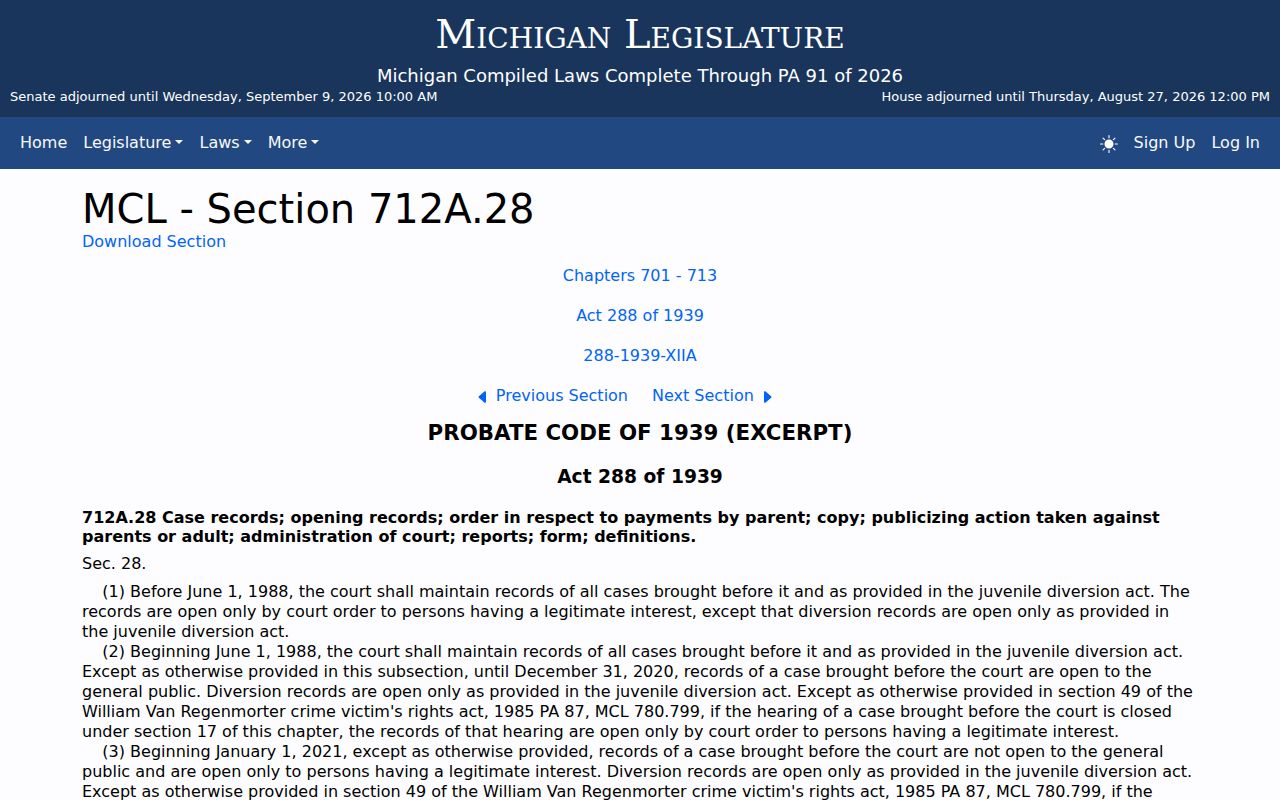
That Montmorency County limitation concerns access to the record, not any conclusion about the matter behind it. Ask the responsible clerk whether an access rule, a court order, or a redacted-copy path applies.
Key rules: MCR 8.119 generally allows inspection and copying of public court records while directing clerks to maintain nonpublic designations. MCL 780.621d sets application requirements and waiting periods for eligible conviction set-aside requests handled by the convicting court.
Montmorency County Criminal Record Copies
The register helps you spot an event, but it won't hand you paperwork. The local Case Search page states plainly that it provides no document copies. Need the charging document, the plea, a signed order, a judgment, or the sentencing record? Ask the Montmorency County District clerk first. Do that while the case sits at the district stage. Once a bindover moves it up, ask the County Clerk. Include the court and case number. Add the party or defendant name, the document you want, the rough docket date, your format choice, a return address, and contact details.
Fees follow state law unless something special applies. Certification itself generally costs $10. The per-page rate is $1 under MCL 600.2546. That applies to a certified copy from a Michigan circuit, district, or probate court. The plain-copy rate, mailing charge, and turnaround are not posted as a court schedule. Confirm them before you send money. Court-case requests go to the clerk first under MCR 8.119. County-held administrative material is different. The county FOIA route works as a fallback once the county says that route is proper.
To reach District staff, use kcheedie@montcounty.org or fax 989-785-8036. The Circuit page lists County Clerk email cneilsen@montcounty.org. County administrative records go through the Montmorency County FOIA route at Attn: FOIA, P.O. Box 789, Atlanta, MI 49709, again only after the county confirms it is the right custodian. Expect an answer within five business days. One extension is allowed, capped at ten more business days.
Hearing recordings follow their own process on the local request form. A CD costs $20 prepaid, plus $8 postage if mailed. Only parties may get recordings. Transcript requests go to a contracted firm, which returns a quote and an estimated production time.
Note: Confirm copy charges, delivery method, and access status first. Ask the clerk before mailing payment for a criminal court record.