
Montmorency County Civil Docket Searches
Montmorency Courts Case Search is the local starting point for a Montmorency County civil docket lookup. It routes you to separate MiCOURT tenants. One serves the 88-2 District Court. One covers the 26th Circuit/Family/Juvenile/FOC group. Another belongs to Montmorency Probate Court. A public result from a Montmorency County tenant can include the register of action, hearing dates, party names, counsel, case status, and financial history. Document copies are not part of the package.
Pick the right Montmorency County court before you trust a name match. General-civil, small-claims, and summary-proceeding matters run through the 88-2 District tenant. Major civil claims belong to the Circuit tenant. Probate has its own tenant. Some Family Division material carries access limits that ordinary public civil dockets do not. Treat MiCOURT as informational rather than the official record. So confirm the court and case number before relying on any result.
The same Montmorency County navigation points to Self-Help Public Computer Access. The clerk does not publish its location or hours. Call the proper Montmorency County clerk before counting on a public terminal.
- Identify whether the Montmorency County matter belongs in District, Circuit, Probate, or Family before opening a tenant.
- Use the Montmorency County case number when available, or search a party or business name and add given-name information only as needed.
- Check the Montmorency County court, filing date, case type, caption, and status before selecting the matching record.
- Read the Montmorency County register in date order, including service, response, setting, motion, order, judgment, and later enforcement entries.
- Ask the proper Montmorency County clerk for the actual filing, signed order, judgment, or certified copy.
Note: The Montmorency County online register can find a civil case and its event dates, but the underlying document image is not included.
Montmorency County Civil Docket Venue
The main venue question for any Montmorency County civil docket is simple. Is it District, Circuit, or Probate? Per Michigan District Court jurisdiction material, Montmorency County District civil claims stop at $25,000. That court also takes small claims, summary proceedings, land-contract forfeiture, and other limited civil matters. For the jurisdiction math, use the Montmorency County amount claimed. Keep it apart from fees, costs, and interest.
Above that line, the Montmorency County 26th Circuit Court serves as the general-jurisdiction trial court. It handles major civil actions and any remedy not assigned to District or Probate. Probate stays separate for estates, trusts, guardianships, and conservatorships. Domestic relations and Family Division matters follow their own court and access path. One more thing: a town name in a mailing address does not create a separate municipal civil docket. Montmorency County has no municipal court.
| Montmorency court | Civil docket coverage | Search or records route |
|---|---|---|
| Montmorency County 88th District Court, 88-2 | General civil up to $25,000, small claims, summary proceedings, and related limited matters. | Montmorency County 88-2 MiCOURT tenant and District Civil clerk |
| Montmorency County 26th Circuit Court | Major civil actions, circuit appeals, and public domestic matters as applicable. | Montmorency County 26th Circuit MiCOURT tenant and County Clerk |
| Montmorency Probate Court | Montmorency County estates, wills, trusts, guardianships, conservatorships, and mental-health proceedings. | Montmorency County Probate MiCOURT tenant and Probate register |
Civil Dockets: What They Show
A Montmorency County civil docket opens with the case identity. It then logs events in time order. That timeline is what makes it useful. The public result can establish that a complaint or petition was filed, that a hearing was set, or that an order or judgment was entered. It cannot prove the full text of the filing behind any entry. Financial or post-judgment lines may appear when the court tenant supplies them. But a Montmorency County amount or balance is no substitute for the filed judgment or satisfaction.
| Case identity | Montmorency County court tenant, number, year and type, filing date, status, case caption, judge, and division. A case identifier follows the year, number, and type structure, such as 2025-000123-GC. |
|---|---|
| Parties and counsel | Montmorency County plaintiff or petitioner, defendant or respondent, added parties, and attorney information where supplied. Confirm each counsel role. |
| Service and response | Montmorency County summons or citation, proof or return of service, answer, appearance, default, counterclaim, or crossclaim. |
| Events and settings | Montmorency County motion, notice, order, hearing, continuance or reset, pretrial, trial, settlement, dismissal, or judgment. |
| Later activity | Montmorency County abstract, writ, garnishment, execution, satisfaction, payment or balance, and appeal activity when applicable. |
Read the case type and the court together. Similar captions can appear in more than one Montmorency County tenant. The same name can also sit in a different Probate or Family Division proceeding entirely.
Montmorency County Civil Docket Codes
Case-type codes tell you which Montmorency County civil court holds a register. District codes include GC for general civil, SC for small claims, and SP for other summary proceedings. Circuit codes work the same way. They include CZ for other civil, CH for housing or real estate, and CK for contract. Selected automobile, no-fault, and personal-injury types round out the Circuit list.
- Default judgment
- A Montmorency County court-entered judgment after a required response or appearance was missed; service history and the order still matter.
- Nonsuit or voluntary dismissal
- A Montmorency County withdrawal or dismissal of the initiating claim that does not necessarily decide the underlying merits.
- DWOP
- Montmorency County dismissal for want of prosecution, meaning the court dismissed because the case was not actively pursued.
- Satisfaction
- A later Montmorency County entry that a judgment was paid or released; request the filed satisfaction if formal proof is needed.
Treat these Montmorency County codes as search and classification tools, nothing more. The Michigan published case-type lists are safer than assuming one abbreviation means the same thing in every court tenant.
What Cases Fill the Civil Docket
Civil docket categories in Montmorency County follow the court split rather than one combined list. District Court covers general civil claims within its jurisdictional amount. It also takes small claims and summary proceedings. Circuit Court carries the major civil actions and public domestic matters where access rules allow. Probate matters such as estates, trusts, guardianships, and conservatorships stay separate. Even a searcher who files them mentally under civil disputes will not find them on a combined list.
- Montmorency County District general civil claims coded GC.
- Montmorency County small-claims matters coded SC.
- Montmorency County other summary proceedings coded SP.
- Montmorency County Circuit contract, real-estate, and other civil matters coded CK, CH, or CZ.
- Separate Montmorency County Probate Court matters involving estates, trusts, guardianships, or conservatorships.
Family and juvenile categories deserve extra care. A public heading or scheduling entry does not open every related filing to view. Let the exact tenant, case type, and access status guide the Montmorency County search.
Montmorency County Civil Docket Service
Service comes first. Before reading any Montmorency County civil motion, look at what happened with notice and response. The register can show a summons or citation. It may show proof or return of service, alternate service, failed service, an answer, an appearance, or a default. A quiet stretch after filing often means service is still unresolved. And a later motion entry never replaces that history. It is a request, not proof that anyone was told or answered.
The local District civil information keeps the roles straight. Clerks accept filings and fees, but they cannot help with paperwork. For paper service tied to small claims, general civil work, summary proceedings, or eviction orders, the Montmorency County Sheriff's Office is the contact. Call 989-785-4238 for process questions. The register gives you the filing history. The document and service details live in the court file itself.
Be careful before labeling an outcome. Filing an order is one thing; the service and response history behind it is another. When the exact text matters, request the documents directly. Ask the court that holds the file for the signed order, complaint, or proof of service. A quiet Montmorency County register can reflect incomplete service, not a finished or abandoned case.
Hearings on the Civil Docket
Civil settings in Montmorency County take several forms. You might see a motion, status conference, pretrial, trial, or post-judgment proceeding. A settings block may list date, time, room, judge, and setting type. The chronological register keeps every earlier notice and reset. Read the latest dated event. The first setting listed is not always the one still standing. A continuance pushes a hearing to a later date. Yet the old setting stays in the record history.
Montmorency All Court Calendars offers a public, date-focused view. It covers the Circuit, District, Probate/Family/Juvenile, and Friend of the Court docket groups. The calendar itself warns that settings may change. Suppressed or nonpublic matters may be omitted. When a date truly matters, compare the calendar with the case register and call the correct court.
Family Division work adds a routing wrinkle. Original Montmorency filings go to the appropriate County Clerk. Judge copies and scheduling run through the 26th Circuit Court in Alpena under the Family Plan. That split is a good reason to pause. Confirm who holds the file before requesting it or a setting.
Montmorency County Civil Docket Clerks
County government keeps the clerk duties divided by court. The County Clerk serves as Clerk of the 26th Circuit Court. That office holds the court's filings and official record. So a Circuit civil document request starts there. A district file, by contrast, starts with the District Civil Division. The District Civil deputy line is 989-785-8037, and the general District Court line is 989-785-8035. For Circuit and County Clerk matters, call 989-785-8022.
The Circuit Court–Montmorency page lays out the Clerk's role with court files. It also gives the official local context for circuit records.
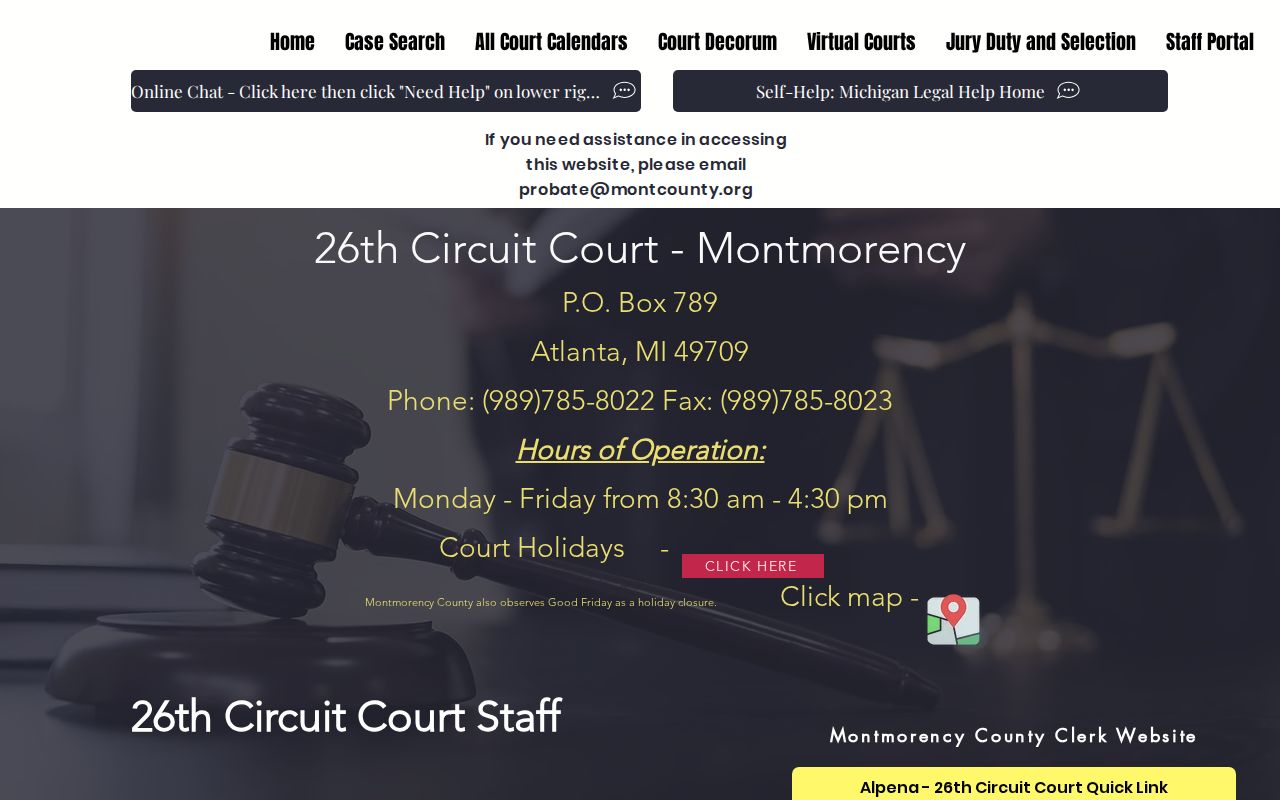
A register search and a document request can travel different roads. The public search identifies the event. The clerk holds the official case file.
Remote requests go smoother with the full picture: court, case number, caption or matter name, the filing you want, an approximate event date, plain or certified format, a return address, and contact information. District public contacts include kcheedie@montcounty.org and fax 989-785-8036. Probate accepts probate@montcounty.org and fax 989-785-8065. The Circuit page lists cneilsen@montcounty.org for the County Clerk. Confirm payment and delivery rules before sending any originals.
Who Can See Civil Dockets
Public access to a Montmorency County civil docket starts with the register of actions. Where the county supplies them, MiCOURT may help. It can show case number and type, filing date, court, status, participants and counsel, register entries, hearing dates, and financial history. It does not publish document copies through the local case-search page. Sealed, family-confidential, juvenile, protected-identifier, personal protection order, and other restricted material may be missing or redacted.
For a court-case record, the appropriate clerk comes first. County FOIA is the fallback for county administrative records, or when the county confirms it is the right holder. A written FOIA request usually gets a response within five business days. One extension is possible, of no more than ten additional business days. That process never opens a sealed court file.
Key rules: MCR 8.119 generally permits inspection and copying of public court records while allowing restrictions under statute, rule, or order. MCL 600.2546 supplies the usual $10 certification plus $1 per-page baseline for circuit, district, and probate copies unless a special provision applies.
A public register entry has limits. It does not override a sealing order or give anyone authority to obtain a protected document.
Montmorency County Civil Docket Outcomes
A civil docket rarely stops when the case ends. The first closing-looking entry is often just the start. A judgment, agreed judgment, default judgment, voluntary dismissal, nonsuit, summary disposition, settlement entry, or DWOP each marks a different court event, and each means something distinct. Afterward the register may fill up with an abstract, writ, garnishment, execution, payment history, satisfaction, or appeal. Stop reading too early and you miss the entries that show where things stand now.
Need proof of the result? Ask the court for the signed order, judgment, or satisfaction itself. The local search page does not hand those over. A certified copy from the clerk is the court-authenticated product. The public register is a discovery tool that helps you pin down the exact date and event wording before you order it.
Older files raise one more question. County history records fires in 1942 and 1943. Ask the Clerk directly whether an older record survived. Never assume a missing portal result means it never existed. The county has not published a current court retention schedule or archive-retrieval fee. Those answers come from the office, not the docket.